

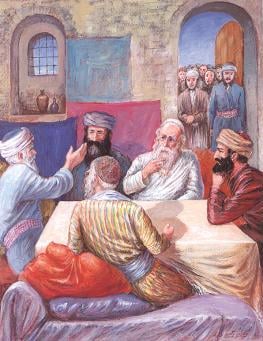
Haggadah means "the telling" and that's what we do at the seder table—we tell a story. The oldest, most popular kind of story there is — the Happy Ending kind. That's how the Talmud instructs us to conduct the seder: "Begin with the bad stuff, and end with the good."
As is usual in the Talmud, the Sages, while agreeing in principle, debate the details. Shmuel says that the bad beginning is, "We were slaves to Pharaoh in Egypt", and the good ending is, "G‑d took us out from there with a mighty hand and outstretched arm." Rav says our story includes the larger picture, starting with how "In the beginning, our ancestors worshipped idols" and culminating in our election as G‑d's chosen people at Mount Sinai.
(So which story do we tell at the seder? Both of them, of course, which is one of the reasons why it takes so long to get to the chicken soup.)
All living creatures communicate with each other in some way. But only humans tell stories.
Only men and women contemplate a chaos of facts, events and experiences spanning days, years, even centuries, isolate a number of them in their minds, draw lines of causality and significance between them, and thus create a story—a piece of life that means something and leads somewhere.
This is why, explain the Chassidic masters, the Talmud considers the "toil of speech" a most basic component of man's special role as a "partner with G‑d in creation." G‑d created an awesome, intricate, yet in many ways a still-undefined world; our storytelling completes the work of Creation, imparting to it coherence and significance.
Once upon a time, many years ago when we were little, we knew the importance of the story. We appreciated how central the act of storytelling is to who and what we are, to our job to make sense of our world and take it somewhere. Then we got old, and tired, and lazy, saying to ourselves: "What is, is. It means nothing; let it be."
Which is why we need lots and lots of kids at the seder.









Thank you! These many yeard living is diaspora, I have not made or attended a seder. This year, with the loving help from your website, I will make a traditional seder for my family and my family of friends. G-d bless.
Donna, it’s April 1, 2020. I was perusing this site in preparation for the upcoming Passover during these difficult times of the virus Quarantine. I usually read the comments after articles and saw yours and couldn’t help but wonder if you indeed made a Seder and how it went. Because of the virus this year, all the Chabads are making passover kits available for those who are doing it the first time or need a little extra help. It probably would have been a great resource for you back then but I’m hoping you did fine. It’s never too late to add a mitzvah or observance. I’m hoping you are well and see this reply. Sincerely, KAREN