

“America is no different!” declared the sixth Lubavitcher Rebbe—Rabbi Yosef Yitzchak Schneersohn, of righteous memory—upon his arrival to America in 1940.
In Soviet Russia, the Rebbe (known as the Previous Rebbe) had galvanized his Chassidim to continue teaching and spreading Judaism in the face of resistance and persecution. He built Jewish underground schools, mikvahs, and synagogues. Due to his heroic efforts, Judaism was kept alive even during the height of communist suppression.
Upon his arrival in the U.S., he declared that “America is no different.” What did the Rebbe mean? While the Rebbe was grateful for religious freedom in America, he understood the upcoming trials of keeping Judaism alive in this new, free world. "Though we are no longer in a life-threatening situation," he urged his followers, "we must remain as vigilant as ever."
Persecution and opposition have many negative consequences, but they can also be the fuel for the oppressed. In America though, the challenges would be different. The Previous Rebbe’s declaration was the vision and inspiration to fuel Jewish growth in this new world of freedom.
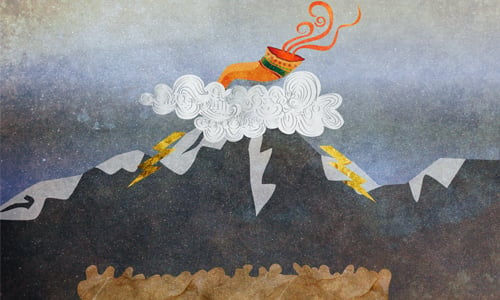
The Torah portion of Behaalotecha hints to these two eras:
While in your land, if you go to war against an enemy that oppresses you, you should blow a long blast with the trumpets so as to be remembered before G‑d, your G‑d, and you will be saved from your enemies.1
And on the days of your rejoicing … You should blow the trumpets.2
The first verse refers to time when the people of Israel are physically threatened, when the trumpet blasts inspire the warriors and ignite the fire of victory. The sounding of the trumpets before battle encourages the people to face the enemy and be victorious. The second verse refers to sounding the trumpets in times of peace.
One may ask, what is the purpose of blasting battle cries after the war?
After the battle of opposition there may be a new battle of complacency. The blasting of trumpets during a time of peace serves as a reminder to keep the competitive forces alive to contend with the challenges that arise from complacency.
Faced with American Jews who were susceptible to apathy, ignorance and indifference, the Previous Rebbe issued the call of “America is no different.” Like the trumpets after the war, this was a clarion call to inspire the Jewish people to continue living a vibrant and meaningful Jewish life.
On a personal level, we are at times faced with doubts, insecurities, and opposition. To this, the first verse says, “Blast the trumpets of war,”—ignite the competitive spirit of battle, change, and growth. For many, our proudest achievements come in the face of our greatest adversity.
Then, there’s the postwar challenge, when we must overcome the complacency and comfort that come from having achieved success. To this, the second verse says, “On the days of rejoicing … blow on your trumpets.” There is still more to accomplish. Rejoice in your victories, but don’t stop sounding your trumpet of growth.3








I think the Previous Rebbe was saying that it was possible to build his movement again in the USA. Until that time the Hassidic dynasties had not yet established themselves in the USA. Remember it was March of 1940. Soviet Jewry had been suppressed for 22 years and Poland, which the Previous Rebbe was fleeing, had recently been conquered and divided by Germany and the Soviet Union. If it was not possible for Chabad to establish itself at that moment in the USA there was really no safe place for it to continue. So by saying "America is not different" he was saying that he could rebuild in this location. America was of course different in that it took him in and protected him because of his religious stature not despite of it.